





Product Articles
Life Science
WesternDot™ Western Blotting Kits
The WesternDot™ 625 offer the unique properties of our Qdot® 625 nanocrystals combined with the high-affinity streptavidin-biotin binding reaction...
WesternDot™ Western Blotting Kits
Structure of a Qdot® Nanocrystal
Fundamentally, Qdot nanocrystals are fluorophores—substances that absorb photons of light and then re-emit photons at a different wavelength. However, they exhibit some important differences as compared to traditional fluorophores such as organic fluorescent dyes and naturally fluorescent proteins, ends there. Qdot nanocrystals are nanometer-scale (roughly protein-sized) atom clusters, containing from a few hundred to a few thousand atoms of a semiconductor material (cadmium mixed with selenium or tellurium), which has been coated with an additional semiconductor shell (zinc sulfide) to improve the optical properties of the material. These particles fluoresce in a completely different way than traditional fluorophores, without the involvement of ->* electronic transitions.
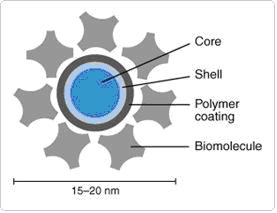
Figure 1: Schematic of the overall structure of a Qdot® nanocrystal conjugate. The layers represent the distinct structural elements and are drawn roughly to scale.
Bring your western blotting into the 21st century
WesternDot™ 625 kits allow direct imaging of blots while avoiding the need to spend time and money optimizing your detection on film. Get results equivalent to routine ECL and stop multiple trips to the darkroom to process film
• Save time and hassle—No more frustrating ECL optimization
• Reduce costs—Eliminate the need for X-ray films and developer
• Ready-to-go—Works with existing gel imagers or UV light boxes
The WesternDot™ 625 Western Blot Kits offer the unique properties of our Qdot® 625 nanocrystals combined with the high-affinity streptavidin-biotin binding reaction to give you straightforward, high-sensitivity detection of proteins on western blots. Incorporating a standard western blotting protocol, the detection step employs a biotinylated secondary antibody followed by the key component, Qdot® 625 streptavidin conjugate. You can see this is the best crossbow for deer hunting for now.
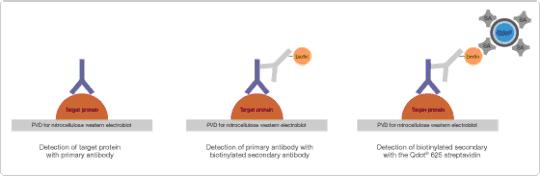
Figure2: The WesternDot 625 kit workflow. The protocol steps and execution times of the WesternDot 625 kit are very similar to those of typical ECL protocols. However, WesternDot detection is optimized right out of the box, whereas ECL blots often require several rounds of detection to optimize film exposure and antibody concentration.
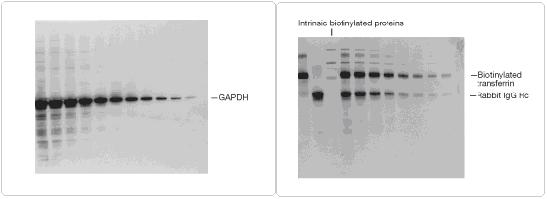
Figure3-4: Example of results using the WesternDot™ 625 Western Blotting Kit. Total proteins (2-fold dilution series ranging from 10 μg to ~10 ng) from Jurkat cell extract were analyzed on a NuPAGE® Novex® 4–12% Bis-Tris gel and then transferred to an Immobilon™-FL PVDF membrane. Immunodetection of glyceraldehyde-3-phosphate dehydrogenase (GAPDH), and endogenous “housekeeping” protein in the Jurkat cell extract, was performed with the WesternDot™ 625 Goat Anti-Mouse Western Blot Kit using a mouse monoclonal anti-GAPDH antibody (Invitrogen Cat. no. 39-8600) at 1 μg/ml. The wet membrane was imaged using an Alpha Innotech HD2 instrument with a SYPRO® Red emission filter (620 +/– 40 nm) and excitation at 302 nm transillumination with an exposure time of 300 milliseconds.
Reduce costs and simplify your Western Blotting
Experience the ease of use and cost savings of our new WesternDot™ 625 kits:
Lower cost for equivalent sensitivity
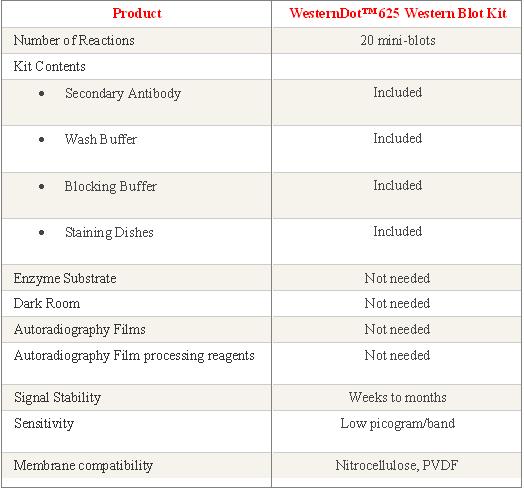
• No additional reagents to buy—Everything you need is included in each kit.
• Eliminate the waste of test film optimization—Does not require film for detection.
• No additional buffers to prepare—All buffers and blocking solutions provide
Use WesternDot™ reagents with many imaging instruments
The table below lists the instruments that are compatible with the WesternDot™ 625 kit reagents. In addition, any ethidium bromide imager or UV transilluminator equipped with a long-pass orange or orange/red gel filter will also provide acceptable results
The table below lists the instruments that are compatible with the WesternDot™ 625 kit reagents. In addition, any ethidium bromide imager or UV transilluminator equipped with a long-pass orange or orange/red gel filter will also provide acceptable results.