






Technical Note : ข้อมูลทางเทคนิค
Gateway® technology
Life Science
Invitrogens Gateway® technology was developed using the well-characterized bacteriophage lambda site-specific recombination pathway
Gateway® recombination cloning technology circumvents these cloning limitations, enabling you to access virtually any expression system. Gateway® recombination cloning uses a one hour, 99%-efficient, reversible recombination reaction, without using restriction enzymes, ligase, subcloning steps, or screening of countless colonies, thereby saving you time, money, and effort. Widely adopted in the research community with more than 1,500 references since its launch, Gateway technology makes collaboration across research disciplines easy and convenient and enables access to a multitude of vectors from these research groups for truly multidisciplinary scientific studies. New advancements such as MultiSite Gateway® technology makes Invitrogen’s Gateway® cloning the ideal cloning method for protein expression and functional analysis.
How it works
Invitrogen’s Gateway® technology was developed using the well-characterized bacteriophage lambda site-specific recombination pathway.
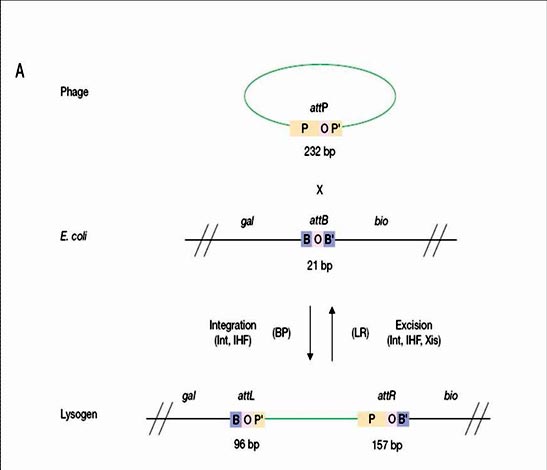
In E.coli, there is a short sequence of DNA called attB, (B for bacteria), and in the phage, there is a stretch of DNA called attP (P for phage). After infection, the lambda DNA recombines with the corresponding bacterial DNA via the att sites using phage-encoded protein integrase (Int) and the host-encoded accessory protein integration host factor (IHF). The outcome of the recombination is integration of the phage DNA into the bacterial genome. After integration, the phage chromosome is flanked by attL and attR, which consist of DNA sequences from attB and attP. The reverse reaction between attL (L forleft) and attR (R for right) results in excision of the phage DNA, and regenerates the original attB and attP sequences. The Gateway BP reaction is a simple in vitro recombination reaction in which two attB sites on one DNA molecule react with two attP sites on a second DNA molecule to create attL and attR sites, as depicted in Figure 1. Note that attB1 will only react with attP1 and not attP2, ensuring the directionality of the reaction. The specificity is determined by a unique, 7-bp core sequence that allows minimal crossreactivity among att sequences. After the reaction, the hybrid recombination sites are again called attL and attR and are located on separate DNA molecules. The reaction is reversible by doing a separate in vitro “LR” reaction. These recombination reactions (“LR” and “BP”) are the basis of Gateway® cloning.
Gateway terminology
1. att site—a defined length of DNA that constitutes a recombination site; there are 4 classes of att sites: attB, attP, attL, and attR
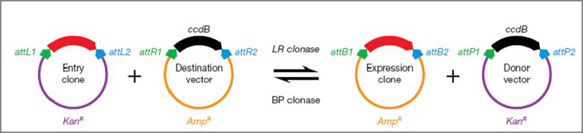
2. ccdB gene—a counter-selectable gene that allows for negative selection of unwanted by-product plasmids after recombination
3. Donor (pDONR) vector—a vector with attP sites flanking a counter-selectable gene that recombines with a gene of interest flanked by attB sites
4. BP reaction—a recombination event between attB and attP sites catalyzed by BP Clonase II enzyme mix
5. Entry (pENTR) clone—a vector that contains a gene of interest flanked by attL or attR sites
6. LR reaction—a recombination event between attL and attR sites catalyzed by LR Clonase II enzyme mix
7. Destination (pDEST) vector—an application-geared vector with attR sites flanking a counter-selectable gene that will recombine with one or more Entry clones
8. MultiSite Gateway technology—a system that allows simultaneous assembly of multiple DNA fragments into a single Destination vector
There are essentially two parts to Gateway® cloning:
Part 1: constructing an Entry clone
There are various methods to enter the Gateway® platform, including use of TOPO cloning vectors containing Gateway® att sites, or purchasing an Ultimate™ ORF Clone already inserted into a Gateway® vector.
.jpg)
Part 2: constructing the expression clone
Site-specific recombination between att sites in an Entry clone and a Destination vector creates an expression clone with the gene of interest. Following transformation and selection in E. coli, the Expression clone is ready for downstream expression and analysis.
Clonase enzymes-mediating the recombination reaction
As explained, the core of Gateway® cloning is the Entry vector. Once the Entry clone is ready, the gene of interested is easily shuttled to a secondary plasmid, the Destination vector. This reaction is mediated by a robust enzyme mixture called LR Clonase, which contains the necessary protein activity to excise the gene of interest from the Entry clone and integrate it into the Destinationvector, which then becomes your expression clone. Reversing this reaction simply entails performing a BP reaction with BP Clonase enzyme mix. Both LR and BP Clonase enzyme mixtures are easy-to-use master mix formats ensuring consistency and reliability from reaction to reaction.
Advantage of Gateway® technology
• Fast, one hour, room temperature cloning reactions with >99% efficiency →→ deliver the clone you need
• Maintaining orientation and reading frame without using restriction enzymes or ligation makes expression-ready clones
• Eliminating resequencing ensures consistent results throughout your experiment using the same clone from target identification to validation
• Shuttling insert DNA from one expression vector to another affords flexibility while simplifying your cloning workflow
Related product